
A Step-by-Step Breakdown of an Actual ES Futures Day Trade
There's no substitute for seeing how real trades unfold in live markets. While day trading education covers theory and strategies, nothing beats examining actual trades—complete with entry reasoning, risk management, and final results. This real-world day trading futures example walks you through an actual E-mini S&P 500 trade, showing exactly how professional traders approach intraday opportunities.
What Is a Real-World Day Trading Example?
A real-world day trading example demonstrates how traders apply strategies, manage risk, and execute trades during actual market conditions. Unlike hypothetical scenarios, these examples show the messy reality of trading—market gaps, slippage, emotional pressure, and split-second decisions that separate profitable traders from those who struggle.
This particular example showcases a measured move strategy in the E-mini S&P 500 futures (ES), one of the most actively traded futures contracts. The trade occurred during a typical trading session, without major news events or extreme volatility—the kind of environment most day traders face daily.
Real-world examples serve as crucial learning tools because they demonstrate how theory translates into practice. They reveal the decision-making process, show how risk management works under pressure, and provide concrete profit/loss calculations that help beginners understand the financial realities of day trading futures.
How Does This Day Trade Work?
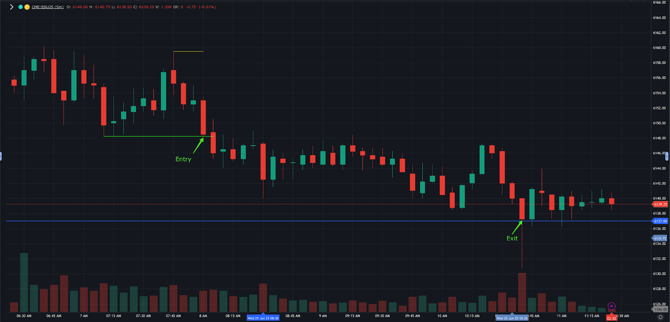
At 6:30 AM PST, the New York markets opened—and the S&P 500 futures (ES) launched into a choppy, indecisive start. With no major economic reports or headlines to drive direction, the market offered nothing but back-and-forth action.
But then, it began to trade directionally.
The Setup: Reading Market Structure
Price action failed multiple times to break above its opening range high (see yellow line), a classic sign of intraday weakness. Professional traders watch these levels religiously because they often define the day's trading boundaries. When price repeatedly fails at the same level, it signals that sellers are overwhelming buyers at those prices.
The trader recognized this pattern and prepared for a potential breakdown. Rather than chase the market or guess at direction, they waited for price to show its hand through actual movement—a hallmark of disciplined day trading fundamentals.
The Entry: Precision Timing
In response to the multiple rejections, the trader positioned a sell stop order at 6148.25, right at a key support level (see green line). This wasn't a guess—it was based on clearly defined technical levels visible on the chart.
Within minutes, the market declined and triggered the short entry. The beauty of using stop orders is that they automate entries at predetermined levels, removing emotion from the decision-making process. No hesitation, no second-guessing—just systematic execution based on predefined criteria.
Risk Management: Protecting Capital First
To manage risk, the trader placed a stop loss just above the latest swing high at 6159.50. This wasn't arbitrary—successful day traders always define their maximum acceptable loss before entering trades. The stop placement above the recent high made technical sense: if price moved above that level, it would invalidate the bearish thesis.
With entry at 6148.25 and stop at 6159.50, the maximum risk was 11.25 points or $562.50 per contract (11.25 × $50 per point). This defined risk approach exemplifies proper risk management fundamentals.
What Makes This Trade Unique?
This example demonstrates several key elements that separate professional day traders from amateurs attempting to day trade futures for beginners.
Measured Move Strategy
For the profit target, the trader used a measured move approach—a technical analysis method that projects profit targets based on previous price movements:
- Formation height: 11.25 points (distance from high to low of the initial move)
- Entry price: 6148.25
- Target: 6148.25 − 11.25 = 6137.00 (see blue line)
This calculation created a clean 1:1 risk-reward ratio—risking 11.25 points to potentially make 11.25 points. While some traders seek higher risk-reward ratios, 1:1 setups can be profitable when executed with high probability entries and proper position sizing.
Systematic Approach Over Gut Feeling
Notice what this trade wasn't: it wasn't based on hunches, news events, or "market feel." Instead, it relied on systematic analysis of price structure, defined entry and exit levels, and mathematical risk-reward calculations. This methodical approach is what allows consistent traders to profit over time.
The trader used technical analysis to identify the setup, order flow concepts to time the entry, and disciplined risk management to protect against adverse moves.
Who Uses These Real-World Trading Strategies?
This type of structured day trading approach attracts various market participants, each bringing different perspectives and capital levels to the markets.
Professional Day Traders
Career traders rely on systematic approaches like this measured move strategy because they provide consistent, repeatable methods for finding profit opportunities. Professional traders understand that day trading isn't about hitting home runs—it's about consistent singles and doubles while avoiding strikeouts.
Part-Time Active Traders
Traders with other jobs appreciate strategies that don't require constant market monitoring. This trade setup could be identified during pre-market analysis, with orders placed before work and managed during lunch breaks. The clearly defined entry, stop, and target levels make remote management possible.
Former Stock Day Traders
Many equity traders transition to futures specifically for trades like this one. The ability to short as easily as going long, combined with superior leverage and no pattern day trading rules, makes futures particularly attractive for systematic strategies.
What Do Day Trading Participants Need to Know?
Success with real-world trading examples like this requires understanding both the technical aspects and the psychological challenges of day trading futures.
Platform Requirements and Execution
This trade demanded fast, reliable execution. The trader needed professional-grade platforms like Optimus Flow Desktop or Optimus Web to handle the real-time order entry, stop management, and profit target execution.
Quality platforms provide features essential for systematic trading: advanced charting, Level 2 market depth, reliable order execution, and real-time bid-ask spread information.
Margin and Capital Requirements
Trading ES futures requires understanding margin requirements. This trade involved one full-size E-mini contract, requiring approximately $15,000-20,000 in overnight margin or $3,000-5,000 in day trading margin, depending on broker requirements.
For beginners, micro E-mini contracts offer the same trading opportunity with 1/10th the size and capital requirements—making this exact strategy accessible to smaller accounts.
Emotional Control and Discipline
The most challenging aspect isn't technical—it's psychological. By 10:40 AM PST, when the market drifted down and hit the target, four hours had passed. Many amateur traders would have closed early due to anxiety, moved their stop loss, or second-guessed their target.
Successful traders stick to their plan regardless of emotional pressure. They understand that consistent execution of systematic strategies outweighs trying to optimize every individual trade.
Key Concepts for Real-World Trading Success
This example illustrates several fundamental concepts that separate consistently profitable day traders from those who struggle with real-world futures day trading strategies.
Structure-Based Entries
The trade wasn't based on indicators or oscillators—it relied on clear market structure. The opening range high provided resistance, the support level provided a logical entry point, and the measured move provided a systematic target calculation.
Understanding market structure and price action patterns forms the foundation for consistent day trading success.
Risk Management Before Profit Optimization
Notice that risk management came first: the stop loss was placed before considering profit targets. This prioritization ensures that losses remain manageable even when trades don't work out as planned.
Stop-loss strategies aren't just about placing stops—they're about accepting predetermined losses to preserve capital for future opportunities.
Systematic vs. Discretionary Elements
While the entry and exit were systematic, the trade selection required discretionary judgment. The trader had to recognize the pattern, assess market context, and decide whether conditions favored this particular setup.
This balance between systematic rules and market judgment represents mature trading development that comes from studying real examples and gaining screen time.
Frequently Asked Questions
How much capital do I need to attempt trades like this ES example?
For full-size ES contracts like this example, you'll need $10,000-15,000 minimum to handle margin requirements and drawdowns. However, Micro E-mini contracts let you execute identical strategies with $2,000-5,000, making this approach accessible to smaller accounts while you develop skills.
What platform features are essential for executing these trades?
You need fast order entry, reliable stop-loss execution, and quality charting. Optimus Flow Desktop provides professional-grade tools, while Optimus Web offers browser-based convenience. Both platforms support the order types and speed required for systematic day trading.
How do you identify these measured move setups in real-time?
Look for clear support/resistance levels that price tests multiple times, then wait for breakdown or breakout. The key is patience—most setups don't work, so you need systematic criteria to filter opportunities. Practice with real-world trading scenarios to develop pattern recognition.
What's the success rate for trades like this measured move example?
Professional traders using systematic approaches typically see 45-55% win rates with positive risk-reward ratios. The goal isn't perfect accuracy—it's consistent execution of strategies with positive expected value over time. Track your own results to understand your edge.
How do you manage trades when working a full-time job?
This trade's beauty is its systematic nature: entry, stop, and target can all be predetermined and placed as orders. Use bracket orders to automate management, but ensure you can monitor positions periodically throughout the day for unusual market conditions.
What happens when these setups fail?
Failed setups trigger your stop loss—that's exactly why it's there. In this example, if price moved above 6159.50, the trader would have lost $562.50 and moved on to the next opportunity. Position management means accepting small losses to preserve capital for winning trades.
How do beginners practice without risking real money?
Start with demo accounts to practice identifying setups and placing orders without financial pressure. Most brokers offer paper trading platforms that simulate real market conditions. Once you can execute strategies consistently in demo mode, open a live account and start with micro contracts.
What market conditions work best for this strategy?
This measured move approach works well in trending or range-bound markets with clear structure. Avoid extremely choppy conditions or major news events that can invalidate technical levels. Focus on understanding market liquidity patterns to optimize timing.
How important is the 1:1 risk-reward ratio?
While higher risk-reward ratios seem better, 1:1 ratios can be profitable with proper position sizing and win rates above 50%. The key is consistency—many traders fail by constantly adjusting risk-reward targets mid-trade. Stick to your systematic approach for statistical validity.
Should new traders start with full ES contracts or micro contracts?
Beginners should absolutely start with micro futures. This exact trade could be executed with MES contracts at 1/10th the risk while learning the same concepts. Graduate to full-size contracts only after proving profitability with smaller positions.
The Final Results: Profit Calculation
By 10:40 AM PST, the market drifted down and hit the target.
Profit Calculation:
- Points captured: 11.25
- Dollar value per point (ES): $50
- Total profit: 11.25 × $50 = $562.50 per contract
This trade is a textbook example of how professional day traders use simple measured moves and risk-managed setups, even in markets that initially show no clear direction.
Ready to practice these strategies? Open a demo account to test systematic approaches like this measured move example before risking real capital.
Next Steps in Your Futures Education
Master the Fundamentals:
- ✅ Real-world day trading example (covered in this article)
- Contract mechanics → What are Futures Contracts?
- Risk management → Understanding Futures Risk
Apply Your Knowledge:
- Market selection → Stock Index Futures
- Position sizing → Position Sizing Principles
- Order execution → Understanding Market Orders
Develop Trading Skills:
- Day Trading Fundamentals for systematic approaches
- Swing Trading Fundamentals for multi-day strategies
- Stop Loss Strategies for capital protection
Ready to Start Trading? Open your futures trading account with competitive margins and professional-grade platforms.
Risk Disclaimer
The content of this guide is the opinion of Optimus Futures.
Futures and options trading involves substantial risk and is not suitable for all investors. Past performance is not necessarily indicative of future results. Examples provided are for illustrative and educational purposes only and should not be construed as specific trading advice or recommendations.
Trading on margin and with leverage carries a high level of risk, as it can amplify both gains and losses.
The placement of contingent orders such as "stop-loss" or "stop-limit" orders will not necessarily limit your losses to the intended amounts, since market conditions may make it impossible to execute such orders. Risk management techniques discussed (such as stops, stop-limits, or bracket orders) cannot eliminate risk.
You should only trade with risk capital—that is, money you can afford to lose without affecting your lifestyle or financial security. There are no “proven” methods or guaranteed systems for making money in futures trading. It is a challenging process that requires ongoing learning, discipline, and adapting to changing market conditions. Traders must carefully consider their financial condition, risk tolerance, and trading objectives before engaging in futures or leveraged markets. It is important to note that most traders do lose money trading futures.