
Real-World Swing Trading Example
A Step-by-Step Analysis of an Actual NQ Futures Swing Trade
Real-world swing trading examples provide invaluable insights into how professional traders identify opportunities, manage risk, and capitalize on multi-day price movements. This detailed breakdown examines an actual Nasdaq-100 futures (NQ) trade that captured a massive $58,860 profit per contract over nearly a month—showing exactly how measured move strategies work in live market conditions.
What Is a Real-World Swing Trading Example?
A real-world swing trading example demonstrates how traders apply swing trading fundamentals during actual market conditions, complete with catalysts, entry reasoning, risk management, and final results. Unlike theoretical scenarios, these examples show the complexity of real trading—fundamental catalysts, technical confirmation, emotional challenges, and the patience required to hold positions across multiple trading sessions.
This particular example showcases how a major policy announcement created the fundamental backdrop for a technical setup in NQ futures, one of the most actively traded stock index futures contracts. The trade demonstrates how swing traders combine fundamental catalysts with technical analysis to identify high-probability opportunities.
Real-world examples serve as crucial learning tools because they reveal the complete decision-making process, show how risk management works under real pressure, and provide concrete profit calculations that help beginners understand the financial potential of disciplined swing trading.
How Does This Swing Trade Work?
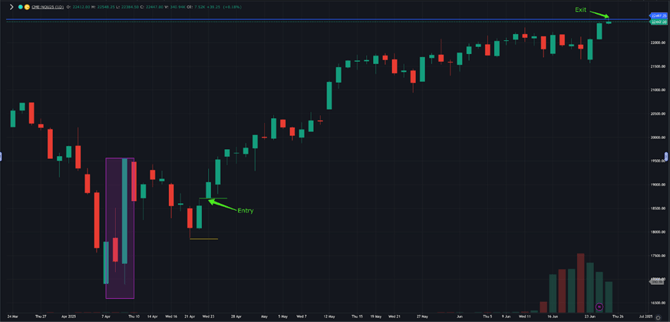
On April 19, 2025, the U.S. announced a 90-day pause on broader tariffs, easing trade tensions and triggering renewed optimism across equity markets—especially tech. One experienced trader anticipated a strong rebound in the Nasdaq-100 futures (NQ), recognizing that policy uncertainty removal often leads to significant market moves.
The Fundamental Catalyst
The tariff pause announcement provided the fundamental catalyst that swing traders seek—a clear policy shift that could drive sustained market movement over days or weeks. Unlike day trading examples that focus on intraday price action, swing trades often begin with macro-level catalysts that create multi-day trending opportunities.
Technology stocks, which comprise a significant portion of the Nasdaq-100, are particularly sensitive to trade policy due to global supply chain dependencies. The trader recognized that removing trade uncertainty could unlock pent-up buying demand across the tech sector.
Technical Confirmation and Entry
The following Monday, NQ briefly dipped but found support near 17,873.25, signaling a potential bottom. This technical level provided the precise entry zone the trader had identified during weekend analysis—a perfect example of how swing traders use extended time between sessions to plan methodically.
The next morning, as momentum picked up, the trader entered a long position at 18,727.50 near the close of the session. This entry came after price action confirmed the bounce from support and showed sustained buying interest throughout the day.
The trader also placed a stop-loss at the presumed bottom (17,872.25), just below the technical support level. This stop placement made logical sense—if price violated the support that had held during the initial decline, it would invalidate the bullish thesis.
What Makes This Trade Unique?
This example illustrates several key elements that separate professional swing traders from amateur attempts at multi-day trading.
Measured Move Strategy Application
To calculate a realistic profit target, the trader used a measured move approach—taking the range between the most recent swing high and previous swing low:
- Swing high: 19,551
- Swing low: 16,608
- Range: 2,943 points
By adding that 2,943-point range to the entry price of 18,727.50, the trader set a profit target at 21,670.50—a level that was hit on May 15.
This systematic approach to target setting demonstrates professional methodology. Rather than hoping for arbitrary price levels or trying to "ride trends forever," experienced swing traders use mathematical frameworks to define logical profit objectives.
Risk-Reward Calculation
The trade setup offered compelling risk-reward characteristics:
- Entry: 18,727.50
- Stop: 17,872.25
- Target: 21,670.50
- Risk: 855.25 points ($17,105 per contract)
- Reward: 2,943 points ($58,860 per contract)
- Risk-Reward Ratio: 1:3.44
This favorable risk-reward ratio allowed the trader to be profitable even with lower win rates—a crucial aspect of sustainable swing trading that emphasizes position sizing principles.
Who Uses These Swing Trading Strategies?
This type of fundamental-technical approach attracts various market participants who understand the value of combining macro analysis with precise execution.
Professional Futures Traders
Career traders appreciate swing strategies that don't require constant screen time while offering substantial profit potential. The ability to analyze setups over weekends and place orders with predetermined risk parameters makes swing trading attractive for professionals managing multiple strategies.
Part-Time Active Traders
The extended timeframe makes this approach accessible to traders with full-time jobs. The fundamental catalyst (tariff announcement) provided several days advance notice, while the technical setup could be identified during evening analysis and executed during lunch breaks.
Former Stock Swing Traders
Many equity swing traders migrate to futures for the superior leverage and extended trading hours. This NQ example demonstrates how familiar technical concepts apply to futures markets while offering enhanced profit potential through futures leverage.
What Do Swing Trading Participants Need to Know?
Success with real-world swing trading requires understanding both the opportunities and challenges of holding leveraged positions across multiple trading sessions.
Fundamental Analysis Integration
This trade's success stemmed from correctly interpreting the tariff announcement's likely market impact. Swing traders must stay informed about policy developments, economic data releases, and sector-specific news that could affect their positions over extended holding periods.
Key fundamental considerations include:
- Policy announcements and regulatory changes
- Earnings seasons and corporate developments
- Economic data releases and Federal Reserve communications
- Geopolitical events that affect market sentiment
Platform Requirements for Multi-Day Positions
Unlike day traders who need millisecond execution speed, swing traders require platforms optimized for analysis, alerts, and position monitoring. Essential features include:
- Advanced charting with multiple timeframe analysis
- Alert systems for price levels and news events
- Mobile access for position monitoring during work hours
- Reliable order management for multi-day positions
Optimus Flow Desktop provides comprehensive analysis tools, while Optimus Mobile Apps ensure you can monitor positions regardless of location.
Margin and Risk Management
This NQ trade required substantial margin due to the contract size and overnight holding requirements. Understanding futures margin requirements is crucial for swing trading success.
For this trade example:
- Initial margin: Approximately $20,000-25,000 per contract
- Maximum risk: $17,105 per contract (855.25 points × $20 per point)
- Position sizing consideration: Account should accommodate 3-5% maximum risk per trade
Micro futures contracts offer identical strategic opportunities with 1/10th the size and capital requirements, making these approaches accessible to smaller accounts.
Key Concepts for Swing Trading Success
This example demonstrates several fundamental concepts that distinguish successful swing traders from those who struggle with multi-day position management.
Catalyst-Driven Setup Identification
The most powerful swing trades combine fundamental catalysts with technical setups. The tariff pause provided the fundamental reason for sustained movement, while the technical support bounce offered precise entry timing.
This integration of fundamental analysis with technical patterns represents mature trading development that goes beyond simple chart pattern recognition.
Patience and Emotional Control
From entry on April 19th to target achievement on May 15th, this trade required nearly a month of patience. During this period, the trader had to:
- Resist urges to take profits early during intermediate highs
- Maintain confidence despite normal pullbacks
- Avoid adjusting the systematic profit target based on emotions
This emotional discipline separates successful swing traders from those who struggle with multi-day position management.
Systematic vs. Discretionary Elements
While the entry and exit used systematic measured move calculations, recognizing the tariff announcement's significance required discretionary judgment. This balance between systematic rules and market interpretation exemplifies mature swing trading development.
Frequently Asked Questions
How much capital do I need for NQ swing trades like this example?
For full-size NQ contracts, plan for $25,000-40,000 minimum to handle margin requirements and potential drawdowns. However, Micro NQ contracts allow identical strategies with $3,000-6,000, making this approach accessible while learning swing trading fundamentals.
How do you identify fundamental catalysts for swing trades?
Monitor policy announcements, earnings calendars, Federal Reserve communications, and sector-specific news. Use economic calendars and news services to anticipate events that could drive multi-day price movements. The key is understanding which announcements create sustained rather than temporary market reactions.
What platform features are essential for swing trading futures?
You need comprehensive charting, alert systems, and reliable mobile access. Optimus Web Trader provides browser-based convenience, while desktop platforms offer advanced analysis tools. Mobile capabilities are crucial for monitoring positions during business hours.
How do you calculate measured move targets accurately?
Identify clear swing highs and lows on daily or weekly charts, measure the range between them, then project that distance from your entry point. In this example: 19,551 - 16,608 = 2,943 points, added to entry 18,727.50 = 21,670.50 target.
What happens when fundamental catalysts fail to produce expected moves?
Failed setups trigger your stop loss—exactly why predetermined stops are essential. In this example, if NQ dropped below 17,872.25, the trader would have accepted the $17,105 loss and moved to the next opportunity. Risk management fundamentals prioritize capital preservation over individual trade success.
How do you manage swing positions during work hours?
Use alert systems to monitor key price levels and set contingent orders for stop losses and profit targets. Mobile platforms allow quick position checks during breaks. The beauty of swing trading is that it doesn't require constant monitoring like day trading approaches.
Should beginners start with full NQ contracts or micro contracts?
Beginners should absolutely start with Micro NQ contracts. This exact strategy could be executed with MNQ at 1/10th the risk while learning identical concepts. Graduate to full-size contracts only after proving profitability with smaller positions.
How important are risk-reward ratios in swing trading?
The 3.44:1 risk-reward ratio in this example allows profitability even with 25-30% win rates. Swing traders should target minimum 2:1 ratios to build statistical edges over time. Never compromise predetermined risk-reward targets based on emotions or market movements.
What role does market sentiment play in swing trade success?
Market sentiment provides context for technical setups. The tariff pause created positive sentiment that supported the technical bounce. Understanding market sentiment analysis helps swing traders position on the right side of prevailing psychology.
How do you know when to exit swing trades early?
Stick to your systematic profit targets unless fundamentals change dramatically. Early exits based on emotions or short-term volatility often reduce long-term profitability. If you must exit early, use technical levels rather than arbitrary decisions.
The Final Results: Profit Breakdown
By May 15th, NQ reached the measured move target at 21,670.50.
Profit Breakdown in Ticks and Dollars:
- Each NQ index point equals 4 ticks, and each tick is worth $5
- So, 2,943 points × 4 ticks = 11,772 ticks
- 11,772 ticks × $5 = $58,860
Total market profit: $58,860 per contract
This trade exemplifies how combining fundamental catalysts with technical analysis and systematic risk management can produce exceptional results in futures swing trading. The key wasn't predicting the exact target—it was recognizing a high-probability setup and executing it with discipline.
Ready to develop systematic swing trading approaches? Open a futures trading account with professional analysis tools and competitive margins designed for multi-day strategies.
Next Steps in Your Futures Education
Master the Fundamentals:
- ✅ Real-world swing trading example (covered in this article)
- Contract mechanics → What are Futures Contracts?
- Risk management → Understanding Futures Risk
Apply Your Knowledge:
- Market selection → Stock Index Futures
- Position sizing → Position Sizing Principles
- Order execution → Understanding Market Orders
Develop Trading Skills:
- Day Trading Fundamentals for short-term strategies
- Swing Trading Fundamentals for multi-day approaches
- Stop Loss Strategies for capital protection
Ready to Start Trading? Open your futures trading account with competitive margins and professional-grade platforms.
Risk Disclaimer
The content of this guide is the opinion of Optimus Futures.
Futures and options trading involves substantial risk and is not suitable for all investors. Past performance is not necessarily indicative of future results. Examples provided are for illustrative and educational purposes only and should not be construed as specific trading advice or recommendations.
Trading on margin and with leverage carries a high level of risk, as it can amplify both gains and losses.
The placement of contingent orders such as "stop-loss" or "stop-limit" orders will not necessarily limit your losses to the intended amounts, since market conditions may make it impossible to execute such orders. Risk management techniques discussed (such as stops, stop-limits, or bracket orders) cannot eliminate risk.
You should only trade with risk capital—that is, money you can afford to lose without affecting your lifestyle or financial security. There are no “proven” methods or guaranteed systems for making money in futures trading. It is a challenging process that requires ongoing learning, discipline, and adapting to changing market conditions. Traders must carefully consider their financial condition, risk tolerance, and trading objectives before engaging in futures or leveraged markets. It is important to note that most traders do lose money trading futures.